inquiry
laat een bericht achter
Als u geïnteresseerd bent in onze producten en meer details wilt weten, laat dan hier een bericht achter, we zullen u zo snel mogelijk antwoorden.
indienen
Bengbu Longkai Lasbeschermingstechnologie Co., Ltd.
Thuis

papr-ademhalingsmasker

papr-ademhalingsmasker

  • Demolition Work: Choosing the Right PAPR
    Demolition Work: Choosing the Right PAPR
    Jan 20, 2026
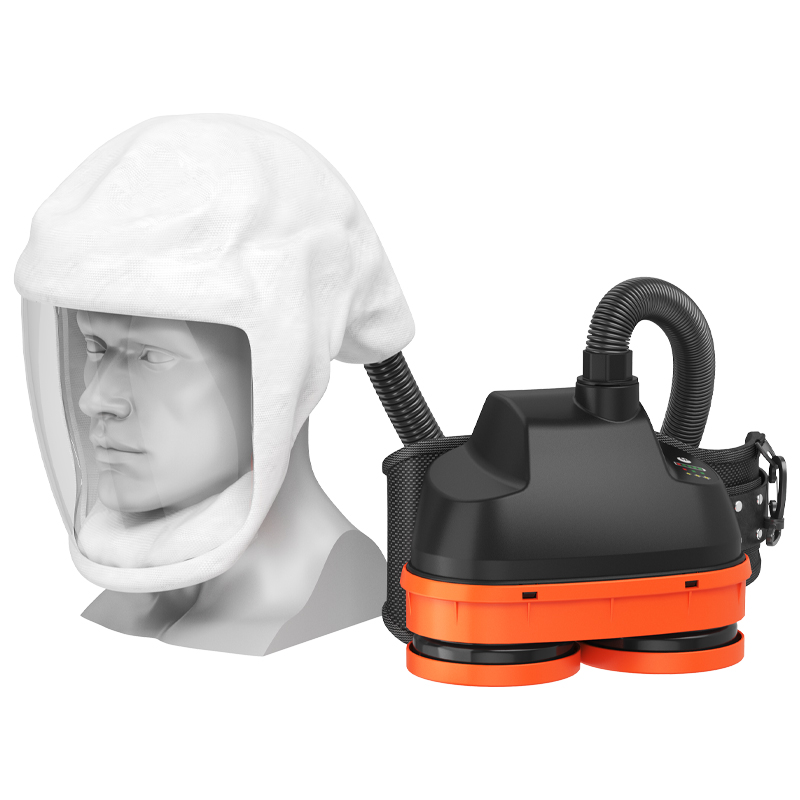
      Demolition work involves complex and variable environments. From breaking down walls of old buildings to dismantling industrial facilities, pollutants such as dust, harmful gases, and volatile organic compounds (VOCs) are pervasive, placing extremely high demands on respiratory protection for workers. battery powered respirator have become core protective equipment in demolition work due to their advantages of positive pressure protection and low breathing load. However, not all PAPRs are suitable for all scenarios; selecting the right type is essential to build a solid line of defense for respiratory safety. Compared with traditional negative-pressure respirators, PAPRs actively deliver air through an electric fan, which not only reduces breathing fatigue during high-intensity operations but also prevents pollutant leakage through the positive pressure environment inside the mask, significantly improving protection reliability.   For general dust-generating demolition operations, particulate-filtering PAPRs are preferred. Such operations commonly involve the demolition of concrete, masonry, wood, and other components, with respirable dust—especially PM2.5 fine particles—as the primary pollutant. Long-term inhalation can easily induce pneumoconiosis. When selecting a model, high-efficiency particulate filters should be used, and the mask can be chosen based on operational flexibility needs. For open-air scenarios such as ordinary wall breaking and floor demolition, air-fed hood-type PAPRs are more suitable. They do not require a facial fit test, offer strong adaptability, and can also provide head impact protection. For narrow workspaces with extremely high dust concentrations, it is recommended to use tight-fitting full-face PAPRs, which have a minimum air flow rate of no less than 95L/min, forming a tight seal on the face to prevent dust from seeping through gaps.   For demolition operations involving harmful gases, combined-filtering PAPRs are required. During the demolition of old buildings, volatile organic compounds such as formaldehyde and benzene are emitted from paints and coatings, while the dismantling of industrial facilities may leave toxic gases such as ammonia and chlorine. In such cases, a single particulate-filtering PAPR cannot meet protection needs. Dual-filter elements (particulate + gas/vapor) should be used, with precise selection based on pollutant types: activated carbon filter cartridges for organic vapors, and chemical adsorption filter elements for acid gases. For these scenarios, positive-pressure tight-fitting PAPRs are preferred. Combined with forced air supply, they not only effectively filter harmful gases but also reduce pollutant residue inside the mask through continuous air supply, while avoiding poisoning risks caused by mask leakage.   Special scenarios require targeted selection of dedicated loose fitting powered air purifying respirators. Demolishing asbestos-containing components is a high-risk operation—once inhaled, asbestos fibers cause irreversible lung damage. PAPRs complying with asbestos protection standards should be used, paired with high-efficiency HEPA filters. Additionally, hood-type designs must be adopted to avoid fiber leakage due to improper wearing of tight-fitting masks. Meanwhile, the hood should be used with chemical protective clothing to form full-body protection. For demolition in confined spaces such as basements and pipe shafts, oxygen levels must first be tested. If the oxygen concentration is not less than 19% (non-IDLH environment), portable positive-pressure PAPRs can be used with forced ventilation systems. If there is a risk of oxygen deficiency, supplied-air respirators must be used instead of relying on PAPRs.   PAPR selection must balance compliance with standards and operational practicality.  Adjustments should also be made based on labor intensity: most demolition work is moderate to high intensity, so Powered Air Purifying Respirator TH3 are more effective in reducing breathing load, preventing workers from removing protective equipment due to fatigue. Battery life must match operation duration—for long-term outdoor operations, replaceable battery models are recommended to ensure uninterrupted protection. Furthermore, filter elements must be replaced strictly on schedule: gas filter cartridges should be replaced within 6 months of opening, or immediately if odors occur or resistance increases, to avoid protection failure.   Finally, it should be noted that PAPRs are not universal protective equipment, and their use must be based on a comprehensive risk assessment. Before demolition work, on-site testing should be conducted to identify pollutant types, concentrations, and environmental characteristics, followed by selecting the appropriate PAPR type for the scenario.  Only by selecting and using PAPRs correctly can we build a reliable barrier for respiratory health in complex demolition work, balancing operational efficiency and safety protection.If you want know more, please click www.newairsafety.com.
    LEES VERDER

  • PAPR Air Inlet Modes: Practical Differences & Selection Logic
    PAPR Air Inlet Modes: Practical Differences & Selection Logic
    Jan 16, 2026
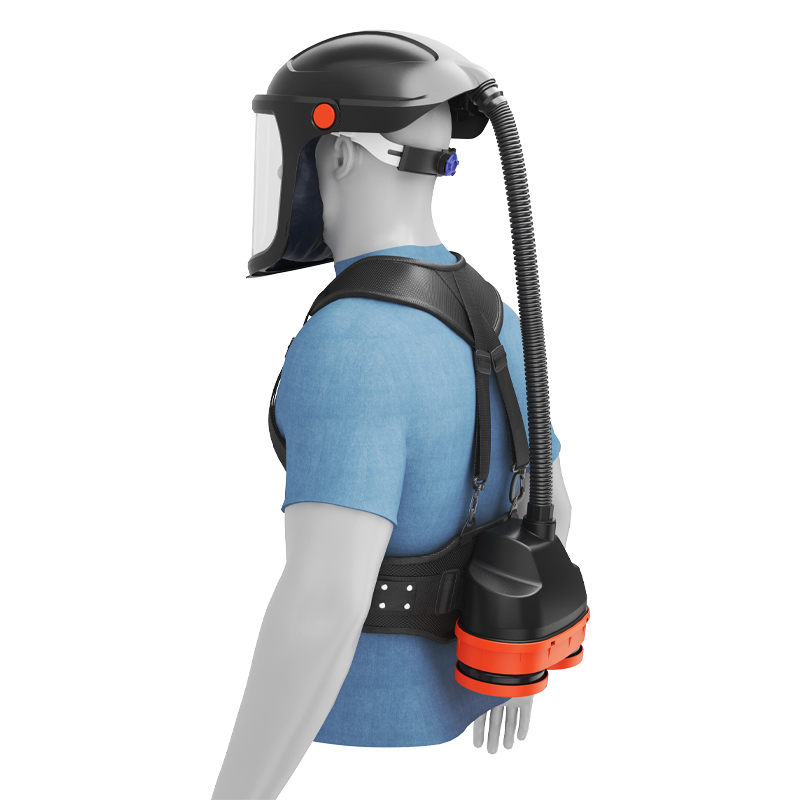
      In air purification respirator application scenarios, most users focus more on filtration efficiency and protection level, but often overlook the potential impact of air inlet modes on actual operations. this article focuses on the differences of front, side and back air inlet modes in wearing adaptability, scenario compatibility, energy consumption control and special population adaptation from the perspective of on-site operational needs. The choice of air inlet mode is not only related to protection effect but also directly affects operational continuity, equipment loss rate and employees' acceptance of the equipment. Its importance becomes more prominent especially in scenarios with multiple working condition switches and long-term operations.   The core competitiveness of front air inlet PAPR lies in lightweight adaptation and emergency scenario compatibility, rather than simple air flow efficiency. This design concentrates the core air inlet and filter components in front of the head, with the overall equipment weight more concentrated and the center of gravity forward, adapting to most standard head shapes without additional adjustment of back or waist load, being more friendly to workers who are thin or have old back injuries. In emergency rescue, temporary inspection and other scenarios, the front air inlet PAPR has significant advantages in quick wearing; without cumbersome hose connection, it can be worn immediately after unpacking, gaining time for emergency disposal. However, potential shortcomings cannot be ignored: the forward center of gravity may cause neck soreness after long-term wearing, especially when used with safety helmets, the head load pressure is concentrated, making it unsuitable for continuous operations of more than 8 hours; at the same time, the front air inlet is easily blown back by breathing air flow, leading to moisture condensation on the surface of the filter unit, which is prone to mold growth in high-humidity environments, affecting filter service life and respiratory health.   The core advantage of side air inlet PAPR is multi-equipment coordination adaptability and air flow comfort, which is the key to its being the first choice for comprehensive working conditions. In industrial scenarios, workers often need to match safety helmets, goggles, communication equipment and other equipment. The arrangement of the side air inlet unit can avoid the equipment space in front of and on the top of the head, prevent mutual interference, and not affect the wearing stability of the safety helmet. Compared with the direct air flow of the front air inlet, the side air inlet can achieve "face-surrounding air supply" through a flow guide structure, with softer air flow speed, avoiding dryness caused by direct air flow to the nasal cavity and eyes, and greatly improving tolerance for long-term operations. Its limitations are mainly reflected in bilateral adaptability: single-side air inlet may lead to uneven head force, while double-side air inlet will increase equipment volume, which may collide with shoulder protective equipment and operating tools; in addition, the flow guide channel of the side air inlet unit is narrow; if the filtration precision of the filter unit is insufficient, impurities are likely to accumulate at the flow guide port, affecting air flow smoothness.   The core value of back air inlet papr air purifier lies in extreme working condition adaptation and equipment loss control, especially suitable for high-frequency and high-intensity operation scenarios. Integrating core components such as air inlet, power and battery into the back, only a lightweight hood and air supply hose are retained on the head, which not only completely frees up the head operation space but also avoids collision and wear of core components during operation, significantly reducing equipment maintenance and replacement costs. The weight of the back component is evenly distributed; matched with adjustable waist belt and shoulder straps, it can disperse the load to the whole body. Compared with front and side air inlets, it is more suitable for long-term and high-intensity operations. Moreover, the long back air flow path can be equipped with a simple heat dissipation structure to alleviate equipment overheating in high-temperature environments. However, this mode has certain requirements for the working environment: the back component is relatively large, unsuitable for narrow spaces, climbing operations and other scenarios; as the core connection part, if the hose material has insufficient toughness, it is prone to bending and aging during large limb movements, and dust is easy to accumulate on the inner wall of the hose, making daily cleaning more difficult than front and side air inlet equipment.   The core logic of selection is the adaptive unity of "human-machine-environment", rather than the optimal single performance. If the operation is mainly temporary inspection and emergency disposal with high personnel mobility, front air inlet PAPR should be preferred to balance wearing efficiency and lightweight needs; for regular industrial operations requiring multiple protective equipment and long operation time, side air inlet is the choice balancing comfort and coordination; for high-frequency, high-intensity operations with strict requirements on equipment loss control, back air inlet is more cost-effective. In addition, special factors should be considered: front air inlet should be avoided in high-humidity environments to prevent moisture condensation; back air inlet should be excluded in narrow space operations, and lightweight front or side air inlet should be preferred; for scenarios with high communication needs, side air inlet is easier to coordinate with communication equipment.   The iterative design of papr respirator air inlet modes is essentially the in-depth adaptation to operational scenario needs. From the initial front air inlet to meet basic protection, to the side air inlet balancing comfort and coordination, and then to the back air inlet adapting to extreme working conditions, each mode has its irreplaceable value. For enterprises, selection should not only focus on equipment parameters but also combine feedback from front-line workers and detailed differences of operation scenarios, so that PAPR can become an assistant to improve operational efficiency rather than a burden while ensuring safety. In the future, with the popularization of modular design, switchable air inlet modes may become mainstream, further breaking the scenario limitations of a single air inlet mode.If you want know more, please click www.newairsafety.com.
    LEES VERDER
  • Belangrijkste componenten van gasmaskerbussen: "Gerichte formuleringen" afgestemd op "beschermde gastypen"
    Belangrijkste componenten van gasmaskerbussen: "Gerichte formuleringen" afgestemd op "beschermde gastypen"
    Aug 26, 2025
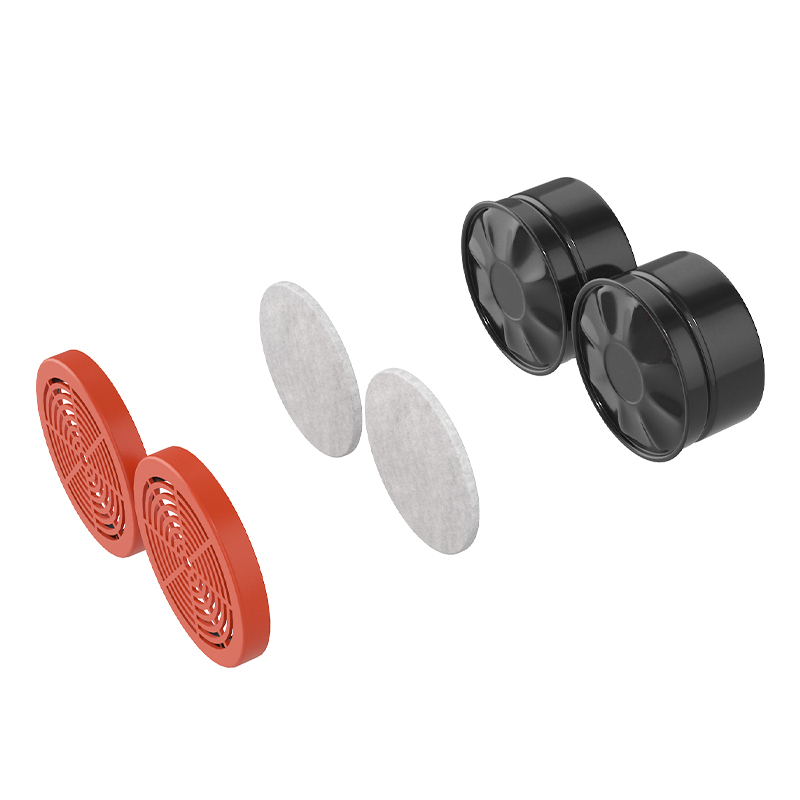
    De kerncomponenten van gasmaskerbussen variëren aanzienlijk, afhankelijk van het beschermingsdoel (serie A/B/E/K). In wezen worden "specifieke componenten gebruikt om de chemische eigenschappen van specifieke gassen te bepalen" – een precisie die essentieel is wanneer deze bussen worden gecombineerd met Aangedreven luchtzuiverende ademhalingstoestellen, die niet kan compenseren voor niet-passende of ineffectieve filtermaterialen. Hieronder volgt een uitleg die overeenkomt met de eerder genoemde gastypeclassificatie, met de nadruk op de relevantie voor PAPR:​1. Voor serie A (organische gassen/dampen, bijvoorbeeld benzeen, benzine): actieve kool als kern​Hoofdbestanddeel: actieve kool met een hoog specifiek oppervlak (meestal kokosnootschaalkoolstof of koolstof op basis van steenkool, met een porositeit van meer dan 90%. Het oppervlak van 1 gram actieve kool is gelijk aan dat van een voetbalveld).Werkingsprincipe: Maakt gebruik van de "fysische adsorptie" van actieve kool – organische gasmoleculen worden door de "van der Waals-krachten" in de microporiën van actieve kool geadsorbeerd en kunnen niet met de luchtstroom in de ademhalingszone terechtkomen. Dit maakt het ideaal voor gebruik in papr-aangedreven luchtzuiverende ademhalingstoestellen Wordt gebruikt bij schilder- of oplosmiddelverwerkingstaken, waarbij continue blootstelling aan organische dampen een betrouwbare, langdurige adsorptie vereist.Verbeterde optimalisatie: voor organische gassen met een laag kookpunt in serie A3 (bijvoorbeeld methaan en propaan, die extreem vluchtig zijn) wordt 'geïmpregneerde actieve kool' (met kleine hoeveelheden stoffen zoals siliconen toegevoegd) gebruikt om de adsorptiecapaciteit voor kleine moleculaire organische gassen te verbeteren, wat cruciaal is voor positieve druk luchtzuiverende beademingsapparatuur gebruikt in olieraffinaderijen of aardgasverwerkingsfabrieken. 2. Voor serie B (anorganische gassen/dampen, bijvoorbeeld chloor, zwaveldioxide): chemische adsorbentia als hoofdcomponent​Hoofdbestanddeel: Geïmpregneerde actieve kool + metaaloxiden (bijv. kopersulfaat, kaliumpermanganaat, calciumhydroxide).Werkingsprincipe: De meeste anorganische gassen zijn sterk oxiderend of irriterend en moeten door middel van "chemische reacties" worden omgezet in onschadelijke stoffen. Bijvoorbeeld:Chloor (Cl₂) reageert met calciumhydroxide om calciumchloride te vormen (een onschadelijke vaste stof);Zwaveldioxide (SO₂) wordt geoxideerd tot sulfaat (dat zich na oplossing in water in het filtermateriaal vastlegt) door een reactie met kaliumpermanganaat.Deze chemische stabiliteit is een must voor aangedreven luchtzuiverende ademhalingstoestellen die worden gebruikt in chemische productie-installaties, waar plotselinge pieken in de concentratie van anorganische gassen snelle en effectieve neutralisatie vereisen.​3. Voor serie E (zure gassen/dampen, bijvoorbeeld zoutzuur, waterstoffluoride): alkalische neutralisatoren​Hoofdbestanddeel: Kaliumhydroxide (KOH), natriumhydroxide (NaOH) of natriumcarbonaat (op actieve kool of inerte dragers).Werkingsprincipe: Maakt gebruik van een "zuur-base-neutralisatiereactie" om zure gassen om te zetten in zouten (onschadelijk en niet-vluchtig). Bijvoorbeeld:Zoutzuur (HCl) reageert met kaliumhydroxide om kaliumchloride (KCl) en water te vormen;Waterstoffluoride (HF) reageert met natriumhydroxide om natriumfluoride (NaF, een vaste stof) te vormen, waardoor corrosie van de luchtwegen wordt voorkomen.Deze corrosiebestendige formule is essentieel voor aangedreven luchtzuiverende ademhalingstoestellen die worden gebruikt in beitswerkplaatsen of bij de productie van halfgeleiders, waar zure dampen zowel gezondheids- als apparatuurrisico's opleveren.​4. Voor serie K (ammoniak- en aminegassen/-dampen, bijvoorbeeld ammoniak, methylamine): zure adsorbentia​Hoofdbestanddeel: met fosforzuur (H₃PO₄) geïmpregneerde actieve kool of calciumsulfaat.Werkingsprincipe: Ammoniak en aminen zijn alkalische gassen en worden gebonden door middel van "zuur-base-neutralisatie". Bijvoorbeeld:Ammoniak (NH₃) reageert met fosforzuur om ammoniumfosfaat ((NH₄)₃PO₄, een vaste stof) te vormen;​Methylamine (CH₃NH₂) reageert met calciumsulfaat om stabiele zouten te vormen die niet meer vervluchtigen.Deze gerichte neutralisatie is essentieel voor aangedreven luchtzuiverende ademhalingstoestellen die worden gebruikt in kunstmestfabrieken of koelhuizen, waar ammoniaklekken een veelvoorkomend gevaar vormen.​III. "Logica van overeenkomsten" tussen structuur en componenten: waarom kunnen gasmaskercilinders niet worden gemengd?​Uit bovenstaande inhoud blijkt dat de "gelaagde structuur" en "componentselectie" van gasmaskerbussen volledig zijn ontworpen rond het "beschermingsdoel". Dit principe is nog belangrijker in combinatie met aangedreven luchtzuiverende ademhalingsmaskers, aangezien deze apparaten zowel de effectiviteit van de juiste bussen als de risico's van onjuiste bussen vergroten:​Als een gasmaskerbus van Serie A (geactiveerde kool) wordt gebruikt ter bescherming tegen zure gassen van Serie E met aangedreven luchtzuiverende ademhalingsmaskers, zullen de zure gassen rechtstreeks in de actieve kool doordringen (er vindt geen neutralisatiereactie plaats) en de continue luchtstroom van de PAPR zal deze ongefilterde gassen rechtstreeks naar de gebruiker brengen;Als een gasmaskerbus uit de K-serie (zuur adsorberend) wordt blootgesteld aan chloor uit de B-serie (sterk oxiderend) in aangedreven luchtzuiverende ademhalingsmaskers, kunnen er nadelige reacties optreden en kunnen er zelfs giftige stoffen worden geproduceerd - stoffen die de PAPR vervolgens in de ademhalingszone brengt.Dit is ook een weerspiegeling van de eerder genoemde 'gouden selectieregel': gasmaskerbussen uit de overeenkomstige serie moeten worden geselecteerd op basis van het type gas in de werkomgeving. Zo wordt gewaarborgd dat de structuur en de componenten echt hun rol spelen, vooral bij integratie met aangedreven luchtzuiverende ademhalingsmaskers.​Conclusie​Een gasmaskerbus is geen "container van één materiaal", maar een geavanceerde combinatie van "gelaagde structuur + gerichte componenten" – ontworpen om harmonieus samen te werken met ademhalingsmaskers met motoraangedreven luchtzuivering. De buitenmantel zorgt voor afdichting van de PAPR-luchtstroom, de voorbewerkingslaag filtert onzuiverheden om de PAPR-efficiëntie te behouden, en de adsorptie-/neutralisatielaag in de kern richt zich nauwkeurig op specifieke gassen om de via PAPR aangevoerde lucht schoon te houden. Uiteindelijk bereikt het het beschermende effect van "het voorkomen van de instroom van schadelijke gassen en het laten ontsnappen van schone lucht". Inzicht in deze details helpt ons niet alleen om gasmaskercilinders wetenschappelijker te selecteren voor standaardmaskers, maar is nog belangrijker voor gebruikers van gemotoriseerde luchtzuiverende ademhalingsmaskers – die vertrouwen op de synergie tussen cilinder en PAPR voor consistente, betrouwbare bescherming. Het stelt ons ook in staat om duidelijker te beoordelen "wanneer cilinders vervangen moeten worden" tijdens gebruik (het beschermingseffect neemt bijvoorbeeld sterk af nadat de adsorptielaag verzadigd is), wat een "bewustzijnsverdedigingslinie" toevoegt voor ademhalingsveiligheid – met name voor degenen die afhankelijk zijn van gemotoriseerde luchtzuiverende ademhalingsmaskers in risicovolle omgevingen. Klik voor meer informatie op www.newairsafety.com.
    LEES VERDER

laat een bericht achter

laat een bericht achter
Als u geïnteresseerd bent in onze producten en meer details wilt weten, laat dan hier een bericht achter, we zullen u zo snel mogelijk antwoorden.
indienen
NEEM CONTACT MET ONS OP: sales@txhyfh.com

Thuis

Producten

Whatsapp

Neem contact met ons op